Monday, June 29, 2015

Lesson 4 - Bugler - Seurat

The film I warned you about!

Ok, interesting film, unaware of why the entire film resolved around one paintings, but it's a pretty darn great painting. 

A Sunday on La Grande Jatte - 1884

This piece painted by Georges Seurat is a master piece that has been studied for years. How do you understand this painting? Where do you begin? The film takes you through the painting and begins to dissect the potential meaning of the multiple scenes associated inside the one large piece. Seurat started painting at the age of 18, once beginning his studies he started to sketch live people. His studying would not last long for he was called off to the military. One piece that came prior to A Sunday on La Grande Jatte was Bathers at Asnieres. 
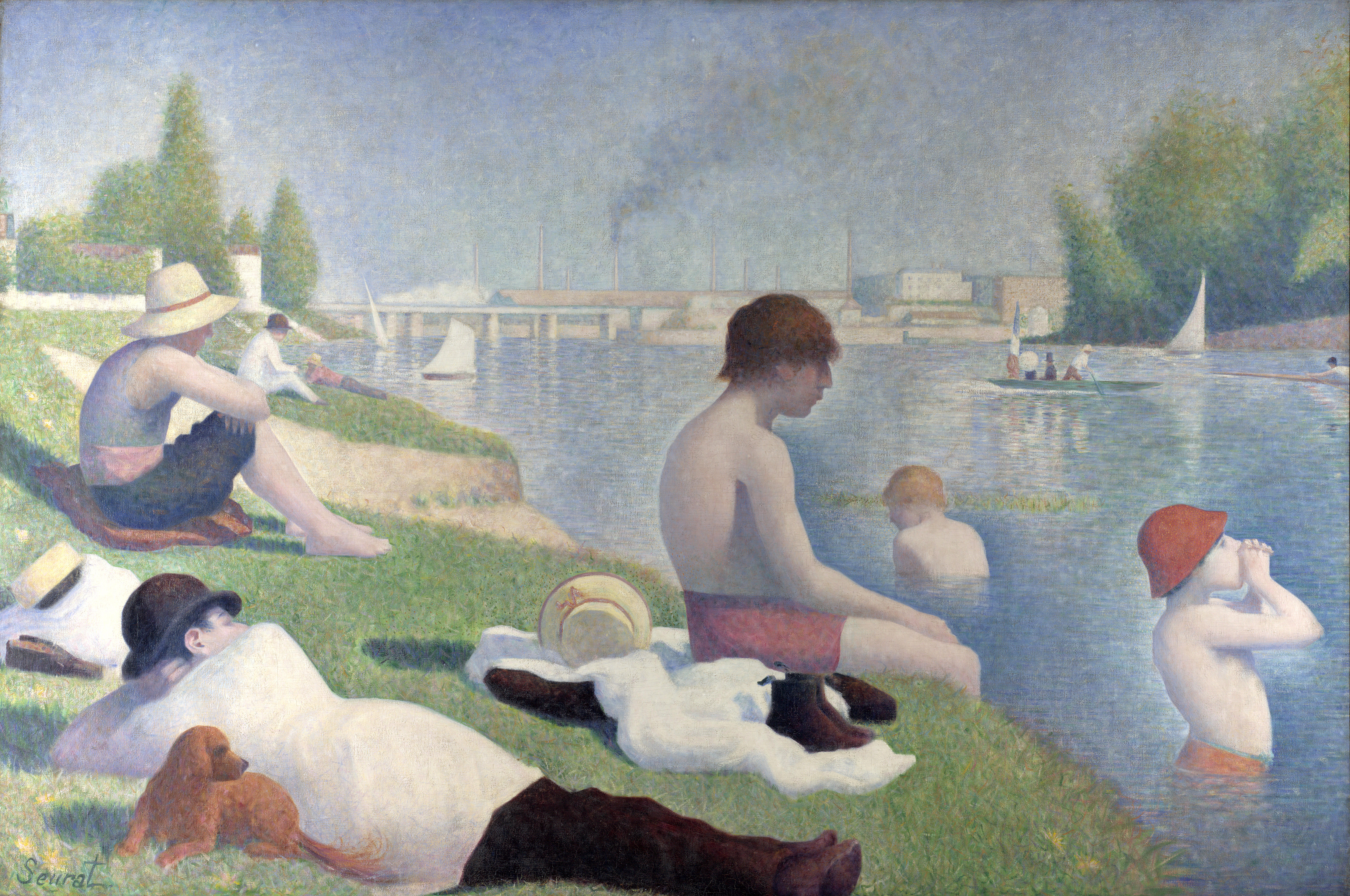

This piece is equal in size to A Sunday on La Grande Jatte, it also lets you peek into his next painting showing the island of La Grande in the background. The beauty of these paintings is that they are created by using small precise strokes, creating a "dot" affect to create these paintings. To provide a broader around each individual instead of a "dot" Seurat used strokes. But why would he use these methods to paint? These techniques were called plot-ism, the layers of color were to make the color appear more vibrant, and vibrant is exact how the painting appeared. 

I have seen this piece before in ads and on commercials. Society has embraced A Sunday on La Grande Jatte as a great piece of satire. An artist in Columbus, Ohio created a garden replicating the 12 ft figures. Another piece came from Stephen Sondheim that created a musical-Sunday in the park with George- showing the struggle and cost of art on those who paint it. In 1900 Chicago had the greatest of luck procuring this masterpiece. Fredrick Clay Barlett purchased the painting for $20,000 and installed it in the Chicago Art Institute. France later realized what painting it had lost and has attempted to pay millions to procure the painting. 
"truly great French master-piece that is not in France,"
The painting went on one trip, to New York. During this visit the New York Museum of Modern Art caught fire; the painting will never leave Chicago again. 

Many have their skepticism of the meaning behind these paintings but we will never know for sure for Georges Seurat passed of  pneumonia prior to telling anyone the true meaning. I like the mystery! It keeps you guessing and ever studying it for it's endless possibilities. 

Lesson 4 - Schama - Van Gogh

An epic reenactment!

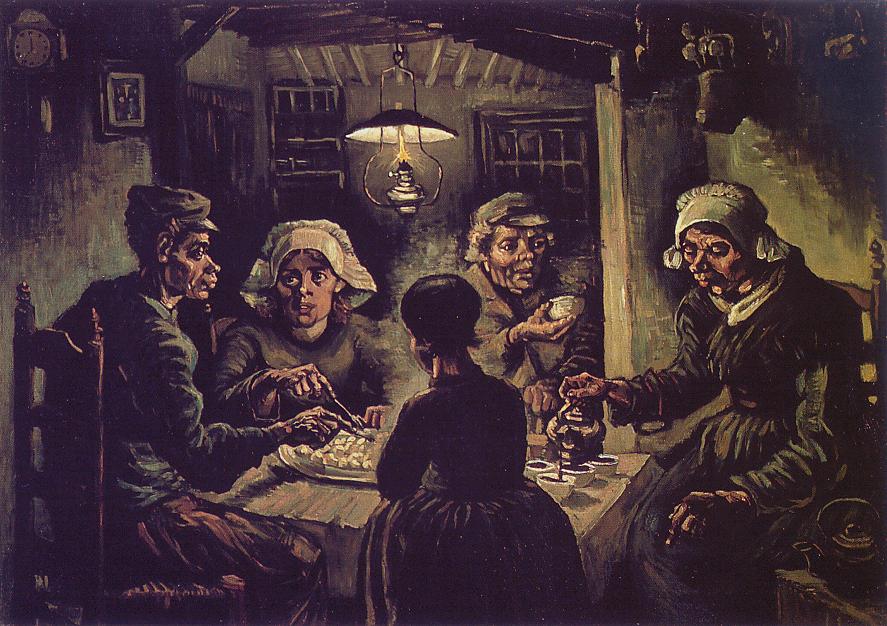
Van Gogh was an artist hunted by his inability to grasp the peoples attention and fighting the demands within. Like many artist he started with humble beginnings, that lead to his desire to become a minister. His time with the ministry was very brief but that did not detour him from wanting to reach out to society and spread God's word, to do so Van Gogh began to paint. "In a way I'm glad I never learned painting, I know for certain that painting is in the very marrow of my bones. I want to do drawings that will touch people. I wanna get to the point that people say to my work that that man feels deeply."With no prior training in painting Van Gogh finished his first piece, the potato eaters. 

The Potato Eaters - Vincent Van Gogh

This gray brown, dirty piece was not a piece the public understood or wanted. This piece shows the individuals who use manual labor to provide their food, it shows hardship. This is Van Gogh first masterpiece and he never knew it. Van Gogh brother who sold his paintings told him to use more colors and that this painting would not sell. With these instructions Van Gogh became addicted to colors such as gold and the beauty of nature. A few of his early paintings incuded His nature was earthier, truer and brighter than other artist. His paintings, Wheat field with Crows, Boots and cut flowers were all great paintings what buyers did not care to buy. To understand Van Gogh you must read his letters to his brother the art dealer. In these letters we find that Van Gogh is not only a very intelligent person but also a very anxious person. The inability to sell paintings isnt making his anxiety any better. The build up of anxiety became too much and Van Gogh suffered from an attack, during this attack to himself Van Gogh cut off his own ear lobe. So what now? Can Van Gogh still paint? Of course! It was just his ear! 
Van Gogh - self portrait 

After committing himself to an asylum Van Gogh started to see things is a newer light. His brush strokes were stronger, and his focus was stronger. In the paintings following his attack we start to see Van Gogh and his thoughts, resulting in Starry Night. 
Van Gogh - Starry Night

Here we see a calmness in the sky, The movements of the swirls and the brightness of colors. This would be a great seller and one that grasp that public's attention in the way that Van Gogh originally set out to do. By painting everyday Van Gogh kept his attacks at bay until one day Van Gogh shot himself in the abdomen, later dying from fever. His closest family member, Theo the art dealer died a year later. Van Gogh did not live to see the impact his paintings have on society but his style and ability to translate movement and paint stokes began a new era of painters. 

Lesson 4 - Lecture

It's another Vblog! Hahaha 


Monday, June 22, 2015

Lesson 3 - Schama - David


David was a painter who became a revolutionary painter of the people. David was a outcast in society, at a young age he was involved in an accident that left his face marked and swollen enabling him to speak. (The movie shows a guy that looks like the Joker) This deformity did not allow him to be accepted into society quickly. Schama explains David in a way more focused on his recognized era instead of his beginning years. During the years of the French Revolution David became a liberal painter. One who spoke through his art in lieu of his speech impediment. One of his first public paintings appeared in the Luve, Paris, France. This painting described the country in crisis and the aid to help it.
David - Oath of the Horatii

David next large revolutionary drawing was one showed in my second post this week. The meetings of nobles, clergy and commoners without the kings permission known as the Tennis Court Oath. The drawing later to become a painting was never finished, individuals at the meeting were later killed.

A painting that I found profound and had very little obvious expression was one illustrating the massacre of July 14th, the beheading of the governor with a fruit knife (painful much?)


David, Jacques-Louis

The photo shows Brutus ordering the execution of his sons for plotting a monarchy, the mother shows emotion as she sees her headless son being carried away. Brutus has an emotionless face until you look at his feet. His feet are twitchy, showing the thoughts that are in his head. 

David would later allow his liberal artwork ban him from France. During the revolution Marat's death needed to be moralized, a showing to the people his death and meaning. Marat was a individual of the commoners who pointed out any person who did not support the new government solely by beheading them. 

Death of Marat - David

David drew his friend in a fictional sense. A body with color of stone, a delicate wound. This drawing wants the people to believe in the cause, that Marat was a person of the people. The box says, he was one of you; the poor, the suffering. The letter in his hand makes him a victim of his kindness, the letter on the box is from a widow and Marat is sending her money. David made Marat out as a godly figure. 

The people saw through this propaganda and banished this painting as well as David from France. 
David was a tyrant of the arts. Moral reeducation is the fullest form of art, David accomplished this idea. 


Lesson 3 - Hughes - Goya

Goya is described as having dark images and a crazy mind, but crazy like a genius. Hughes himself, the narrator of the film has understanding of the mindset of Goya for he himself had a near death experience. I believe this experience is what allows Hughes to identify with the darker paintings of Goya.

Goya was not a peasant, he grew up in a tiny town with his mother. His first large commission was on inside a monk church. Here he was to paint 11 paintings on the inside of the church, no one has ever seen his paintings. Only one painting still exist for he was inexperienced and painted directly on the plaster walls, after damage, the church had them restored by a French painter; only one original remains. Yes he was young when painting these, but his presence was still there, as well as a portrait of himself.

Later works by Goya were critized as cartoons, but Goya mastered what others could not, the ability to please a client. The film then showed a gallery opening for Goya and his women, shown is a very young Queen Elizabeth (this movie is a tad bit old). The women painted by Goya showed every detail from rich, poor, clothed and naked. One portion that I believe the narrator wanted us to know about this part of Goya's life is that he like himself was a creepy old man. (yes i am laughing as I type this) One painting of the Dutchess of Elbow showed he pointing to the sand where Goya had written ONLY GOYA. We then pan to the very first portrait of a naked woman, beautiful and different, Hughes informs us that he would like to jump in the painting and have sex with her. This film is making me a tad bit uncomfortable!

Here and where the Goya of madness appears, in 1792 he becomes ill with vertigo, death and blindness. He overcomes some of the illness but remains death the rest of his life. After this experience his paintings changed forever. Goya was now fighting himself and the madness within. His paintings were of prisons and madhouses, where individuals were not helped but dumped, something inside of his had changed.

Goya - The Meadow of San Isidro on his Feast Day 

Goya - Pilgrimage to San Isidro

The paintings are different but of the similar layout. One very dark, the people have changed from royal to groups of robbers and thieves. They are irrational and profoundly weird. 

During the French Revolution Goya became the correspondent journalist before they even had a title. Many of the scenes drawn by him were to believed to be false and imagined. A man of 62 years old could not have possibly seen these gruesome scenes and escaped.  Two national days were painted by Goya and gained him great acknowledgment. The 2nd day of May (rebirth of Spanish identity), the 3rd of May (the start of the great war of national liberation).

Goya - Third of May - 1808

Goya died in 1828, he was 82 years old. One of his final paintings were a self portrait. A sickly man being forced medicine by his close friend Dr. Areata.

Lesson 3 - Collings - Civilization

"Idea if what we are suddenly changes"

Matthew Collings explored the works of both David the French painter and Goya the Spanish painter. Neither of these painters met during their lives but have significant and similar impacts to the world around them. David's paintings showed us how to feel to be better people, inner nobility. Goya did not show the best of us, but the worst of us.

The film focused on Matthew Collings feelings about the paintings and painters, him moving about museums and cities, well lite and full of his dramatic tone. He really did try to make his voice dramatic and suspenseful, a bit intriguing haha. Similar to the next two films I will be discussing this film provides the background of both Goya and David. I want to focus on their similaries and I can break them down seperately in the next two post.

The feelings portion of the film informed us that both painters were radicals and wanted to move forward into the future for their country. It was the time of the enlightenment. The next segment of the film explores Civilization and the thought of change for the commoners. David and Goya illustrated that change in their art work.

  
David - Oath of the Tennis Court, 1789   
Goya - Charles IV of Spain and His Family          

Lesson 3 - Lecture

I Vlog! First attempt... 2nd attempt next week!